Summary: Amber is fossilized tree resin, not a mineral, formed over millions of years. From Baltic succinite
Amber is not a mineral. That single fact trips up most people who admire its honeyed glow in a jewelry case. It is fossilized tree resin—most often from extinct conifers or angiosperms—that hardened over millions of years into a stable, polymer-like substance. I keep a small piece from the Baltic region on my desk。and every time a visitor picks it up, they ask the same question: “Is this really from a tree” Then they turn it toward the window, and the light does something strange. The stone seems to hold the sun inside it, a slow-burning fire trapped in a shell of time.The oldest known amber dates back roughly 320 million years, to the Carboniferous period. Younger deposits—the famous Baltic amber, for instance—formed around 44 million years ago. That gap matters. It means amber is not a single material but a family of fossil resins, each with its own chemistry and origin story. Dominican amber, often prized for its clarity and range of colors from pale yellow to deep cherry red, comes from an extinct species of legume tree. Burmese amber, some 99 million years old, has yielded spectacular fossils of insects。feathers, and even a tiny dinosaur tail. I once handled a Burmese specimen at a mineral show in Tucson—no larger than a thumbnail, yet it contained a complete spider with its legs curled as if mid-step. The dealer wanted $4,000. I passed, but I still think about that spider.Why does amber preserve such detail?
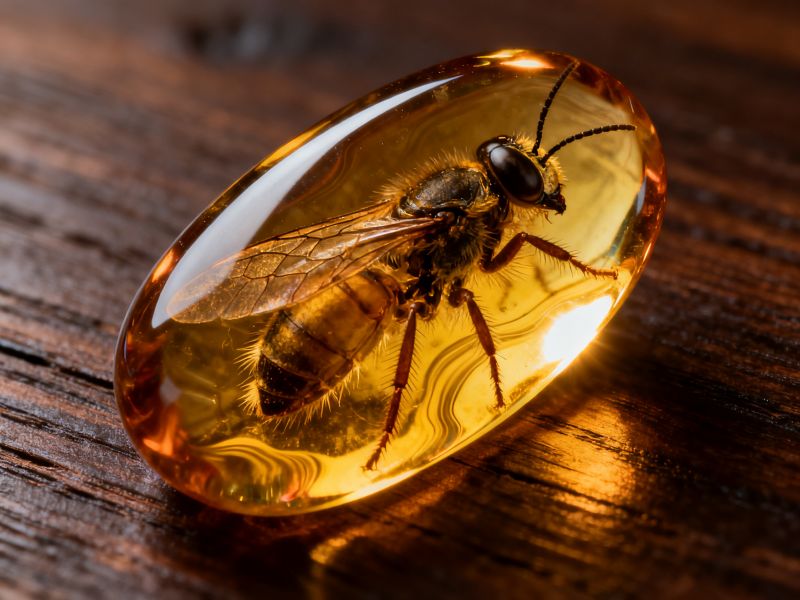
The answer lies in its hardening process. Fresh resin is sticky and chemically active;it traps whatever small creatures blunder into it. Over time, the volatile compounds evaporate。and polymerization turns the resin into a dense, non-reactive solid. Microorganisms can’t easily break it down. Water doesn’t dissolve it. The result is a time capsule with a translucent lid. Not every inclusion survives—soft tissues usually decay—but hard parts like exoskeletons, bones, and plant hairs often remain intact. That’s why amber has become a window into ancient ecosystems, not just a pretty stone.Not all amber is created equal, and the market reflects that. Baltic amber, often called succinite, has a succinic acid content that gives it a distinctive feel and smell when warmed. Heat it gently, and you get a faint piney aroma—one of the few non-destructive tests that doesn’t require a lab. I’ve seen sellers rub a piece on wool and hold it near a straw;
static electricity makes the straw twitch. That trick works because amber is a natural insulator. But beware of copal, a younger resin that hasn’t fully fossilized. Copal looks like amber, feels like amber。and even passes some simple tests, but it’s thousands of years old, not millions. A drop of acetone on a hidden spot will turn copal sticky;true amber stays hard. That’s not a technique you want to try on a finished necklace, though.Beyond the science, amber carries a weight of human history. Neolithic peoples carved it into beads and amulets. The Romans sent expeditions to the Baltic coast to secure supplies—Pliny the Elder complained about the price. In traditional Chinese medicine。amber was ground and used for its supposed calming properties, though I’d advise against ingesting it. Today, amber’s appeal is more about wonder than utility. Hold a piece up to the light and you’re looking through a window into a forest that no longer exists. The insects inside will never move again, but they’ve outlasted mountains. That’s the strange bargain of amber: it turns life into stone, and stone into story.